
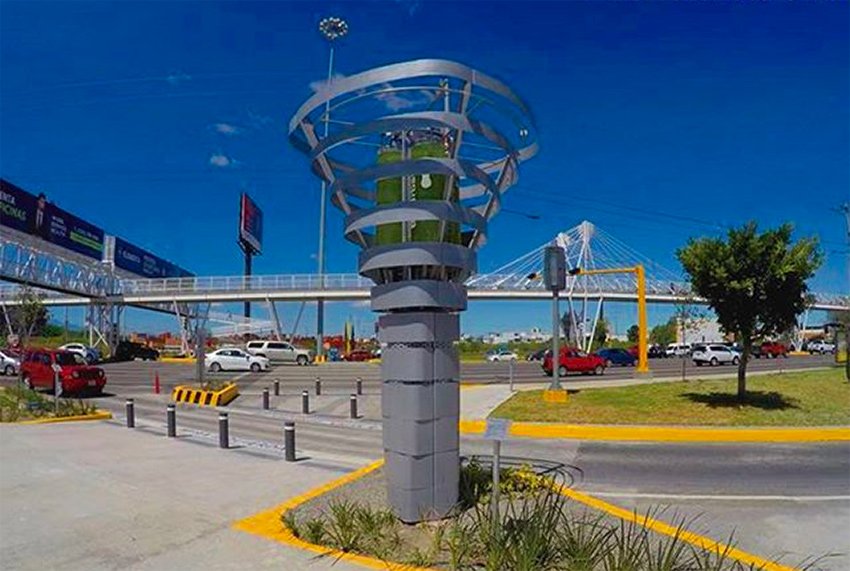
So far, the best solution we have to fight air pollution and climate change is planting trees. But what about cities ? There is no way we can grow a forest in the middle of London, Mexico or New-York. Well, this robot-looking tree invented by BiomiTech might be the solution.
So far, the best solution we have to fight air pollution and climate change is planting trees. But what about cities ? There is no way we can grow a forest in the middle of London, Mexico or New-York. Well, this robot-looking tree invented by BiomiTech could be the solution.
What is it ?
Inside this modern structure, installable at every street corners (and modular to fit elsewhere), there is an air purifying system that captures, filters and cleans the air, using microalgaes’ photosynthesis process to turn CO2 into Oxygen. With this process, BiomiTech claims that their technology can do the same job than 360 trees. This could be a real life-changer in polluted cities.
The robot-tree is self-sustainable, using solar energy as a source of power. Moreover, the waste microalgaes can be reused to produce biofuel. It can also serve as a public wifi router or an air quality sensor which makes it a very interesting invention because it offers a lot of solutions to cities, especially in their transition to become smart-cities. Right now, Mexico has already started to try these air-purifiers / oxygen generators / biomass factories. On a larger scale, it would be great to see these “trees” in every big city, where there is no room for their natural equivalent. At the time I am writing these lines, BiomiTech is aiming to develop more environmental friendly technologies.
How does it work ?
The result of the photosynthesis are oxygen released in the air, and more microalgaes that keep growing as they absorb pollution. These byproducts are then used as raw material for biofuel and biogas.
Why is it useful ?
Air pollution in urban areas is a huge public health issue. BioUrban can absorb air polluants like Carbon Monoxyde and Carbon Dioxydes, Nitrogen Oxydes, and nanoparticles, that are believed to be responsible for the death of 7 millions people each year. Respiratory and heart diseases are more common in urban areas because of the air pollution. More and more cities like New Delhi, Mexico, Sydney, or London are confronted with pollution peaks that can have terrible consequences. Besides, cities release high concentrations of CO2 in the atomopshere which contributes to global warming.
miTech could be the solution.
What is it ?
Inside this modern structure, installable at every street corners (and modular to fit elsewhere), there is an air purifying system that captures, filters and cleans the air, using microalgaes’ photosynthesis process to turn CO2 into Oxygen. With this process, BiomiTech claims that their technology can do the same job than 360 trees. This could be a real life-changer in polluted cities.
The robot-tree is self-sustainable, using solar energy as a source of power. Moreover, the waste microalgaes can be reused to produce biofuel. It can also serve as a public wifi router or an air quality sensor which makes it a very interesting invention because it offers a lot of solutions to cities, especially in their transition to become smart-cities. Right now, Mexico has already started to try these air-purifiers / oxygen generators / biomass factories. On a larger scale, it would be great to see these “trees” in every big city, where there is no room for their natural equivalent. At the time I am writing these lines, BiomiTech is aiming to develop more environmental friendly technologies.
How does it work ?
The result of the photosynthesis are oxygen released in the air, and more microalgaes that keep growing as they absorb pollution. These byproducts are then used as raw material for biofuel and biogas.
Why is it useful ?
Air pollution in urban areas is a huge public health issue. BioUrban can absorb air polluants like Carbon Monoxyde and Carbon Dioxydes, Nitrogen Oxydes, and nanoparticles, that are believed to be responsible for the death of 7 millions people each year. Respiratory and heart diseases are more common in urban areas because of the air pollution. More and more cities like New Delhi, Mexico, Sydney, or London are confronted with pollution peaks that can have terrible consequences. Besides, cities release high concentrations of CO2 in the atomopshere which contributes to global warming.

